
LMT #144: Alameda D. Afonso Henriques, Lisbon, Portugal – Elísio Estanque
Elísio Estanque
Researcher at the Centro de Estudos Sociais, Universidade de Coimbra
The Alameda D. Afonso Henriques is, with regard to the main sites of sociopolitical effervescence, one of the most iconic rallying points in Lisbon since the Carnation Revolution in Portugal on April 25, 1974. Situated in the central part of the capital, the boulevard and gardens that make up Alameda D. Afonso Henriques were inaugurated in the 1940s, in honor of the first king of Portugal. The area is vast and shaped like a gigantic arc, with its lowest point coinciding with the section where Almirante Reis Avenue crosses it. At its highest points, on the western side stands the Instituto Superior Técnico (IST), and on the opposite side, to the east, lies the Fonte Luminosa (from which water cascades). This monument, which stands out at the top of this immense green carpet, hosts entertainment and recreational areas for both adults and children. It is an open field that has marked decisive political turning points in times of profound political change in democratic Portugal.
It is often said that revolutions begin in a dead end. There is no doubt that this metaphor applies to the Portuguese case, given that the Estado Novo regime had been in a dead end since the 1960s. And that is why the military officers from the Movimento das Forças Armadas (MFA) planned and conducted the military action of April 25, a heroic revolutionary act that brought down the decrepit and obsolete wall that was the Salazar-Caetano regime. There were, however, underlying factors leading up to that apotheotic moment that sparked and broadened a social consciousness ready to applaud (and build) democracy. It is from this lesser-known process that I would like to begin with, before turning to the collective clamor of the working class. That clamor found expression in the various squares and avenues of the Portuguese capital, where the Fonte Luminosa became an icon of celebration and freedom.
Just as great rivers are channels for a flow that draws its strength from their smaller affluents, the spread of a revolution follows identical processes; that is, it springs from multiple sources that well up from the interstices of society. In the case of Portugal, revolutionary dreams and social dynamics broke out after April 25, emerging from the most remote corners of the working-class neighborhoods, industrial factories, and the clusters of favelas (shantytowns) where sewage still flowed in the open. Nevertheless, before this flow gained momentum in public sites such as the Alameda D. Afonso Henriques, which became a driving force behind a series of emancipatory actions, it took a considerable amount of organizational work and militant dedication in the struggle for a horizon of freedom. If it is true that the “fall of the wall” of Portuguese fascism took place on a bright spring day, we cannot ignore the fact that the seeds of a culture of dissent began to sprout long before that decisive day 52 years ago.
The emergence of the Portuguese working-class has deep roots that are worth remembering. Between the fall of the monarchy and the demise of the First Republic (1910-1926), class consciousness and the combativity of the labor movement were growing at the rhythm of two forces; first, those associated with the country’s own industrialization process, and second, the echoes of internationalist struggles dating back to the late 19th century. The Portuguese working-class, despite all the particularities deriving from a long-lasting dictatorship, which followed the demise of the republic, continued to be affected by many of those events.
In the year following the establishment of the Estado Novo (the corporatist and fascist political regime led by Salazar), the general strike by the glassworkers of Marinha Grande (1934) shook the regime and even raised the possibility of overthrowing the dictator himself. Over the following decades, marked by severe repression, the country’s industrial hubs, such as the shipbuilding industry south of Lisbon and on the Setúbal Peninsula, the glassmakers of Marinha Grande, the wool mills of Covilhã, and the shoe production in the north, became focal points where the working class emerged as a collective force, resisting Salazarism as best as it could and demonstrating its potential at various moments. It was not only the strike actions, the identity forged on the factory floor, and the role of clandestinely organized trade unions, but also the sociability of daily life in the working-class neighborhoods at the city’s outskirts that played a central role in the formation of the Portuguese working class.
In the early 1970s, amidst the dictatorship, Alameda D. Afonso Henrique was a gathering place for working-class youth coming from proletarian neighborhoods. It became one of the city’s main leisure spots, home to the “Mundial” movie theater, rock concerts, and a lively atmosphere of flirting and dating around the Fonte Luminosa, which set the mood for the surrounding area. As a thoroughfare, Alameda, like Rossio and other streets in downtown Lisbon, was joyfully adorned on the morning of April 25, 1974, with the flowers —white and red carnations—that female street vendors had brought to sell, but which, swept up by the rush of sudden liberation, they spontaneously offered to the MFA soldiers, thereby engraving in the collective memory the main symbol that still defines the Carnation Revolution to this day. However, its defining mark has been consolidated by the many public demonstrations on that area, serving as a rally point or a route for major public demonstrations, particularly those on Labor Day.
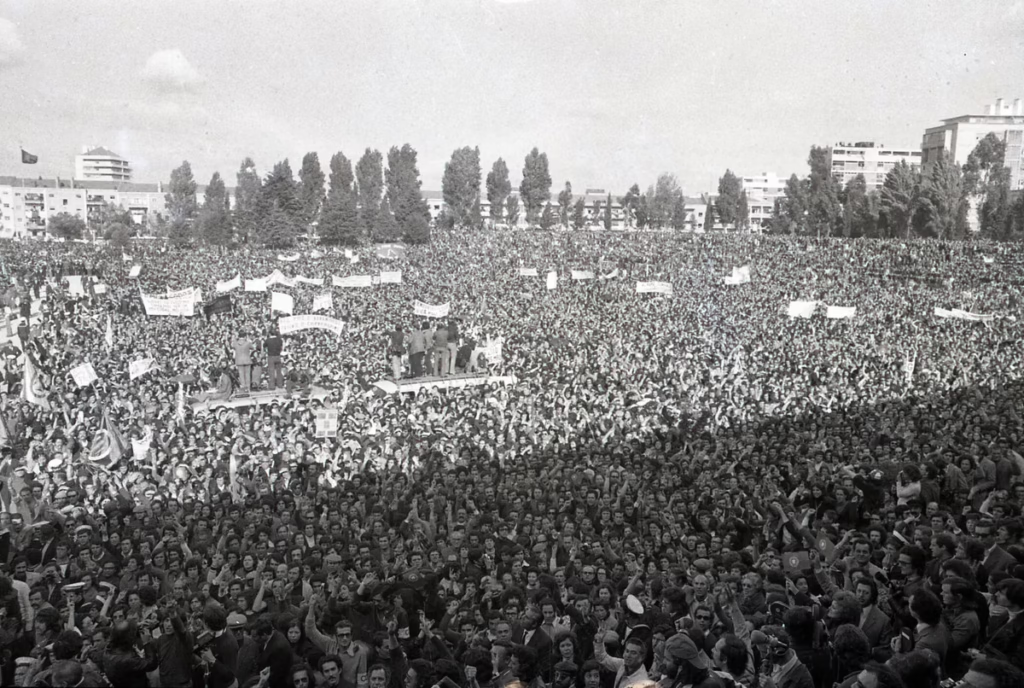
The ‘first act’ of this process occurred on 1 May 1974. It was the moment of greatest impact, a collective ecstasy celebrating the achievement of democracy by the MFA officers a week earlier. With the participation of all political parties in the democratic spectrum, as well as the trade union structures that were already in place at the time (such as the CGTP-IN, the General Confederation of Portuguese Workers – National Inter-Union), this “momentum” was a spontaneous outpouring from all sectors of society celebrating the achievement of freedom and political democracy. In Lisbon, Rossio Square, Liberdade Avenue, Almirante Reis Avenue, and Alameda D. Afonso Henriques were the scene of an impressive collective jubilation, a communion of wills expressed in the phrase “The People United Will Never Be Defeated.” There were rivers of people who, passing through Alameda, flowed into the stadium (which had previously been the sports field of Casa Pia Atlético Clube) and which has since been named Estádio 1º de Maio in honor of Labor Day and precisely because it served as the main stage for that great demonstration. The Alameda’s symbolism derives not only from its centrality, its massive dimensions, but also from the fact that it lies in front of one of Lisbon’s major university hubs (the Instituto Superior Técnico), which in the previous decade had been the main focal point of student protests against the regime.
In short, the Alameda D. Afonso Henriques has been and continues to be a site for the labor and trade union movement’s expressivity since April 25, 1974, but simultaneously it represents a disputed arena where the major sociopolitical tensions and ruptures of the revolutionary period confronted each other. But, still at the height of the revolutionary process (August 1975), this would be the main venue where tens of thousands of Portuguese people responded to the call of Mário Soares (then leader of the Socialist Party) in one of the largest demonstrations of the time—still known today as the Fonte Luminosa rally—in protest against the hegemony of the Portuguese Communist Party within the Armed Forces and against the alleged danger of a “people’s democracy”, under the auspices of the former USSR. Following this turning point, the conditions were created for the neutralization of the communist and left-wing sectors (and the faction within the army that supported them, under the influence of Otelo Saraiva de Carvalho, the operational commander of the April 25th movement), and the way was paved for the pro-European course that would be confirmed on November 25, 1975.
Fifty-two years after the Carnation Revolution, its commemoration remains a source of controversy to this day, due to the ideological conflict that those tense times brought to light. Political freedom, despite the undeniable progress the country has made—evident in sectors such as education, social policy, science, and the economy—has not been enough to solve all problems and has fallen short of many expectations. Wages remain low, the healthcare system is riddled with gaps, there are stark disparities between inland and coastal regions, and shocking economic and gender inequalities; working conditions have been deteriorating over the past few decades, ultimately, migration has become a major phenomenon, fueling new and old resentments and frustrations across many social sectors, which are being seduced by new populist and far-right narratives, giving rise to political forces that threaten democracy itself. As one of the main venues for protests and demonstrations (such as those on May Day), Alameda D. Afonso Henriques in Lisbon remains a stage where many of these struggles continue to take place.

Housing rights demonstration in Lisbon, gathering thousands of people at Alameda Dom Afonso Henriques on September 28, 2024. (Source: https://observador.pt/2024/09/28/milhares-de-pessoas-manifestam-se-em-lisboa-pelo-direito-a-habitacao-protesto-estende-se-a-todo-o-pais/)
Translation: Yasmin Getirana
TO LEARN MORE
Aldo Casas e António Louçã. O PREC e o Relógio das Revoluções. Lisboa, Parsifal, 2023.
Elísio Estanque; Agnaldo Barbosa e Fabrício Maciel (Orgs.). Re-Trabalhando as Classes no Diálogo Norte-Sul: trabalho e desigualdades no capitalismo pós-Covid. S. Paulo: Editora da Unesp, 2024;
Elísio Estanque. Ressonâncias e Sociologia Pública: ensaio sociológico sobre a sociedade portuguesa. Porto: Editora VidaEconómica, 2023;
Irene Flunser Pimentel. Do 25 de Abril de 1974 ao 25 de Novembro de 1975. Lisboa: Temas&Debates, 2024.
Yves Léonard. Breve História do 25 de Abril. Lisboa: Ed. 70, 2024.
Cover image credit: First May Day celebration in democracy at the former FNAT Stadium, 1974 (Diário de Notícias Archive)
WORKING CLASS MEMORY SITES
The Working Class Memory Sites series is coordinated by Larissa Farias, Paulo Fontes, Vinicius Rosalvo e Yasmin Getirana.


